On this page
Before you start
Know where each number lives. The same data shows up in three places, with different depth:
- Pumpfun app. The coin page gives the holder count and which people you follow hold the coin. The Holders tab under the chart lists the wallets.
- pump.fun website. The coin page has a Stats box with holders, top 10, dev, snipers, bundlers and total fees, plus a bubble map.
- Terminal. The Token Data & Security panel adds insiders and fresh wallets, and the Dev Tokens tab shows the creator's past coins.
Every figure is an estimate built from on-chain data. Labels such as sniper or insider come from patterns, not from anyone's confession, and they change by the minute. Read them together and look again before you buy.
What does the Holders tab show?
It lists who holds the coin, how much, and who is up or down. Open a coin in the app, scroll below the chart and tap Holders, next to Callouts and About.
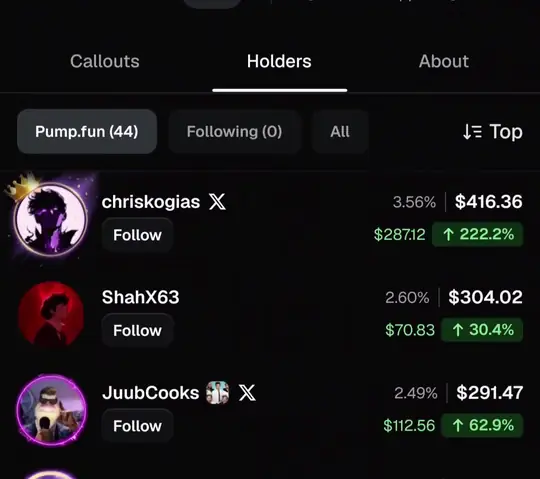
Three filters sit at the top. Pump.fun ranks accounts on the app, Following narrows it to people you follow, and All shows every wallet holding the coin on-chain. Each row gives the share of supply, the value of the position and the holder's profit or loss in dollars and percent. A trader up 222% on a small coin has a reason to sell soon.
The usual mistake is reading only the Pump.fun filter. It counts positions the app has indexed, so buys made through other apps can be missing or undercounted. Switch to All before you judge how concentrated the supply is.
What is a normal top 10 share?
For a young coin, under 30% held by the top 10 is a reasonable line. The top 10 figure is the share of supply held by the ten largest wallets. The pump.fun coin page shows it in the Stats box, and hovering the small question mark explains each number.
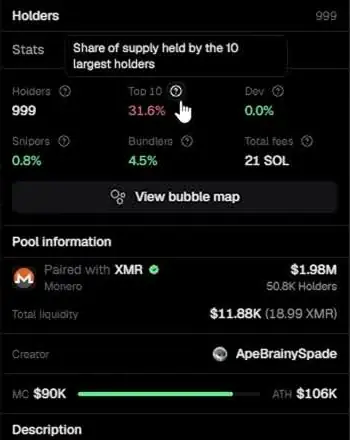
Before you judge it, take out the pool. While a coin sits on its bonding curve, the curve holds the unsold supply. After graduation, the PumpSwap pool holds a large share. Neither is a person. In one case in November 2026, a coin's top 10 read 31% with the liquidity counted and about 19.5% without it.
As a rough guide, with the pool left out: under 20% is well spread. From 20% to 30% is normal for a coin a few hours old. Above 30%, a handful of sales can move the price. Above 50%, a few wallets set the price and everyone else follows.
What do the dev numbers tell you?
They show what the creator holds now and what they did before. On the website, Dev in the Stats box is the share of supply the creator holds. Hover the dev badge next to the coin's name and it repeats the figure.
- Dev under 5%. Normal. The creator has a stake but cannot sink the price alone.
- Dev well above 5%. A bag that can be sold into you. Watch it as you would a whale.
- Dev at 0% within hours of launch. The creator sold the first buy. On a coin months old with an active community, 0% says much less.
History matters more than today's share. Open the creator's profile from the coin page and read how many coins they have created. On the website the creator sits under Pool information. In Terminal, the coin's Dev Tokens tab splits the creator's coins into migrated and non-migrated, with their highest market cap and the date of the last launch. Thirty coins and no graduation is a pattern. Our memecoin trading guide shows that tab in more detail.
What are snipers and bundlers?
Both measure supply bought in the first moments, often by one person. Pump.fun defines snipers as wallets that bought in the first blocks of a coin's life. Bundlers are wallets that bought through bundled transactions. A bundle is many buys sent together, usually by one person spread across a dozen wallets.
Read the share they still hold, not how many there were. Terminal shows snipers as "0% 5": five sniper wallets bought, and together they now hold nothing. That selling is already behind the coin. Snipers holding 15% are another matter: that supply is still waiting for a buyer. Under 10% for snipers and under 10% for bundles are common starting limits.
In the pump.fun holder list, tags such as Sniper, Bundler, Pump user and Tracked mark individual wallets, so you can see whether a flagged wallet sits in the top 10.
What are insiders and fresh wallets in Terminal?
They are Terminal's estimates of wallets tied to the launch and of brand-new wallets. Open the coin in Terminal and find Token Data & Security in the right-hand panel.
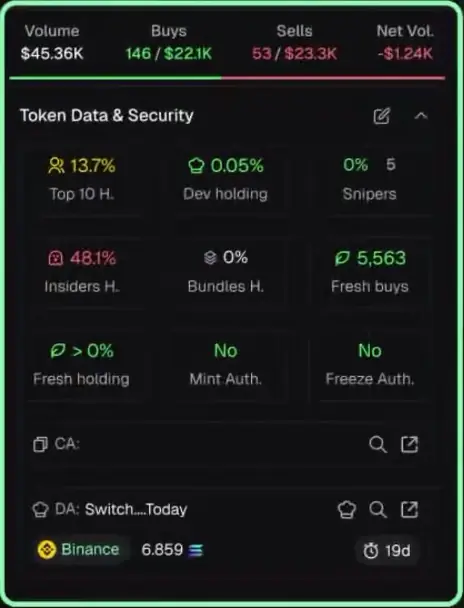
- Insiders H. The share held by wallets Terminal links to the team or the launch. In the panel above, the top 10 hold 13.7% and insiders hold 48.1%. The supply is split across many linked wallets, which is the pattern a plain top 10 figure hides.
- Fresh buys and Fresh holding. Buys from new wallets with little history, and what those wallets still hold. Many fresh wallets buying at once are often one buyer.
- DA. The deployer address, where its first SOL came from and how old the wallet is. Here it was funded with 6.859 SOL from an exchange 19 days earlier.
The Holders tab in Terminal adds funding labels to wallets that were funded at about the same time. Ten wallets funded in the same minute behave like one.
How do you read the bubble map?
Each circle is a holder, sized by its share. Lines show transfers between wallets. On the pump.fun coin page, click View bubble map under the Stats box.
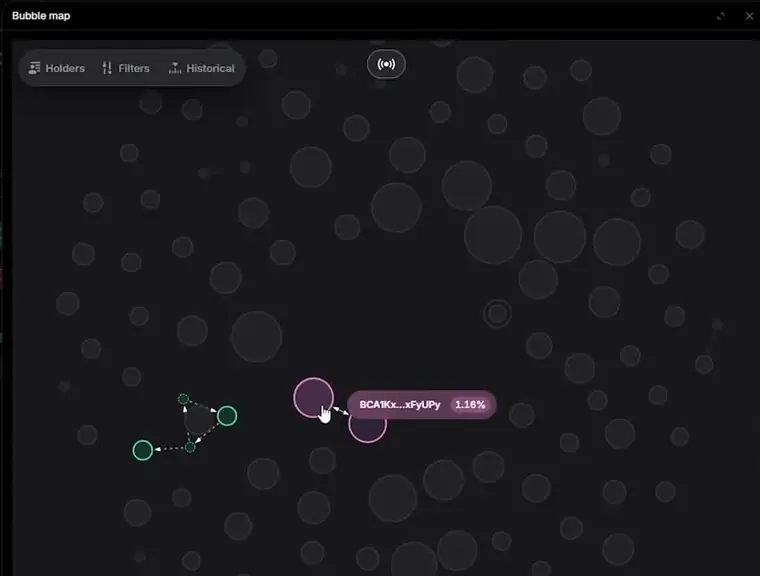
A healthy map is a cloud of separate circles. Look for groups joined by lines, and add up what each group holds. Two linked wallets with 1% each matter little. Twelve linked wallets with 3% each are one holder with 36%, even if none of them shows up as large. Use Historical to see how the map looked earlier, and Filters to narrow it down.
Clusters are not proof. An exchange wallet can link strangers. When the numbers and the map disagree, trust whichever gives the worse answer. Once a coin passes, the rug pull checks cover what comes next. To keep an eye on a wallet you found here, track it.
The one-minute check
- Holders tab on All, not only Pump.fun.
- Top 10 with the pool left out: under 30% on a young coin.
- Dev under 5%, and a creator whose past coins did not all die.
- Snipers and bundlers each holding under 10% now.
- Insiders low compared with the top 10, and no rush of fresh wallets.
- No large linked cluster on the bubble map.
- A buy size you can lose in full, whatever the numbers say.