On this page
What is the Pump Fun bonding curve?
It is the formula that prices a coin before any trading pool exists. It buys and sells the coin itself. Every coin launches with its own curve, run by Pump.fun’s program. You buy from the curve and sell back to it. Nobody adds liquidity, so nobody can pull it.
Each coin has 1 billion units. The curve sells 793.1 million of them. The other 206.9 million wait for graduation, when they go into a PumpSwap pool. Every buy or sell on the curve pays a 1.25% pool fee: 0.30% to the creator and 0.95% to the protocol. Trades in the Pumpfun app or on the website add the platform fee of 0.45%, or 0.40% with a referral code such as BonusReward.
What is the bonding curve formula?
It is constant product, x times y equals k, on virtual reserves. Each curve starts as if it held 30 SOL and 1,073,000,000 coins, so k is 32.19 billion.
- Price per coin = (30 + S) / (1,073,000,000 - T), where S is the real SOL in the curve and T the coins sold so far.
- Coins you get = (1,073,000,000 - T) - 32,190,000,000 / (30 + S + your SOL after fees).
- Market cap = price x 1 billion.
At launch the price is about 0.000000028 SOL and the market cap about 28 SOL. Every buy moves the price up the curve and every sell moves it back down by the same formula. These figures are for SOL-paired coins; USDC-paired coins run on their own numbers in USDC.
What does the progress bar show?
It shows how much of the 793.1 million curve coins have sold. At 100% the curve is empty and the coin graduates.
The bar does not track money in a straight line. Early coins are cheap, so the first half of the bar fills with only about 17.6 SOL, and the second half takes another 67 SOL. A coin at 50% has reached only about 17% of its graduation market cap.
| Progress | SOL in the curve | Market cap (SOL) | Market cap at $89 per SOL |
|---|---|---|---|
| 0% | 0 | 28 | $2,500 |
| 25% | 6.8 | 42 | $3,760 |
| 50% | 17.6 | 70 | $6,290 |
| 75% | 37.3 | 141 | $12,580 |
| 90% | 59.6 | 250 | $22,300 |
| 100% | 85.0 | 411 | $36,720 |
Worked example: what does 1 SOL buy?
This example tracks one 1 SOL buy, placed in the app with code BonusReward, at two points on the same curve.
- Fees first. The 0.40% platform fee takes 0.004 SOL. The 1.25% pool fee comes off the rest, which leaves about 0.984 SOL for the curve.
- At launch, with nothing in the curve: 1,073,000,000 - 32,190,000,000 / 30.984 = about 34.07 million coins, 3.4% of the supply. That one buy moves the bar from 0% to about 4.3%.
- At 50%, with 17.6 SOL in the curve, the same 1 SOL gets about 13.7 million coins, two and a half times fewer.
- Selling runs the formula backwards, and the 1.25% fee applies again on the way out.
Real fills differ a little, because other trades land in the same second and your slippage setting caps the price you accept. For a quick estimate, the progress table and a phone calculator do the job.
When does a Pump Fun coin graduate?
A coin graduates the moment its last curve coin sells. By then about 85 SOL sits in the curve and the market cap is near 411 SOL, about $36,700 at a SOL price of $89. The dollar figure moves with SOL; the SOL figures do not.
Graduation happens on its own. Pump.fun moves the curve’s SOL and the 206.9 million reserved coins into a new PumpSwap pool, takes a 0.015 SOL migration fee from the curve, and burns the pool’s LP tokens so the liquidity can never be withdrawn. Graduated, bonded and migrated all mean the same thing.
Few coins make it. Through 2026 the share of new coins that graduate has mostly stayed between about 0.2% and 1.5% a day, with short spikes after Pump.fun changed its launch incentives. Most coins stall early on the curve and are left there.
What changes after graduation?
It moves to a PumpSwap pool, where the fee depends on market cap.
| Where it trades | Total fee | Creator | Protocol | Liquidity pool |
|---|---|---|---|---|
| Bonding curve | 1.25% | 0.30% | 0.95% | 0% |
| PumpSwap, up to 420 SOL market cap | 1.25% | 0.30% | 0.93% | 0.02% |
| 420 to 1,470 SOL | 1.20% | 0.95% | 0.05% | 0.20% |
| 4,420 to 9,820 SOL | 1.00% | 0.75% | 0.05% | 0.20% |
| 49,120 to 54,030 SOL | 0.55% | 0.30% | 0.05% | 0.20% |
| 98,240 SOL and up | 0.30% | 0.05% | 0.05% | 0.20% |
The tiers in between step down a little at a time. Three other things change:
- Real liquidity sets the price. The pool starts with about 85 SOL against 206.9 million coins, so one large sell can still drop the price hard.
- Other apps can trade it. Aggregators and other wallets route through the PumpSwap pool. In the Pumpfun app and on the website the platform fee still applies.
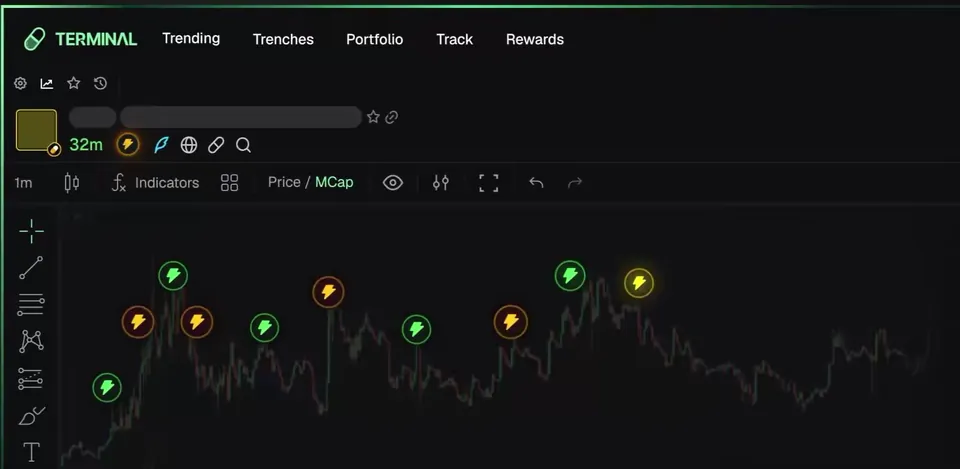
- BOOST runs for five minutes. Since July 21, 2026, part of the liquidity that moves at graduation buys the coin back over the first five minutes, and the coins bought are burned.
On October 13, 2026, Pump.fun said BOOST had put $106M back into the market since it started. Those buybacks help a new pool in its first minutes; they do not stop holders from selling afterwards.
What is King of the Hill on Pump Fun?
It is the Pump.fun website’s featured spot for the curve coin closest to graduating. A coin takes the crown by passing a market cap mark, historically around half of the graduation market cap, and keeps it until another coin passes it.
The crown brings attention, and that is all it tells you. Pump.fun has not published the current rule, and a few wallets often buy a coin into the spot just to win that attention. Check the holder list before you follow them in. Our sniper bot page explains how those early wallets operate.
The two-minute checklist
- Read the progress bar together with the market cap. 50% is still only about 70 SOL of market cap.
- Check what the creator holds and whether a handful of wallets bought in the first seconds.
- Count the fees: 1.25% each way on the curve, plus 0.40% or 0.45% in the app.
- Size the buy so losing all of it is fine. Most coins never graduate.
- After graduation, check the fee tier and whether BOOST buybacks are still running.